How a PHP Day Is Structured
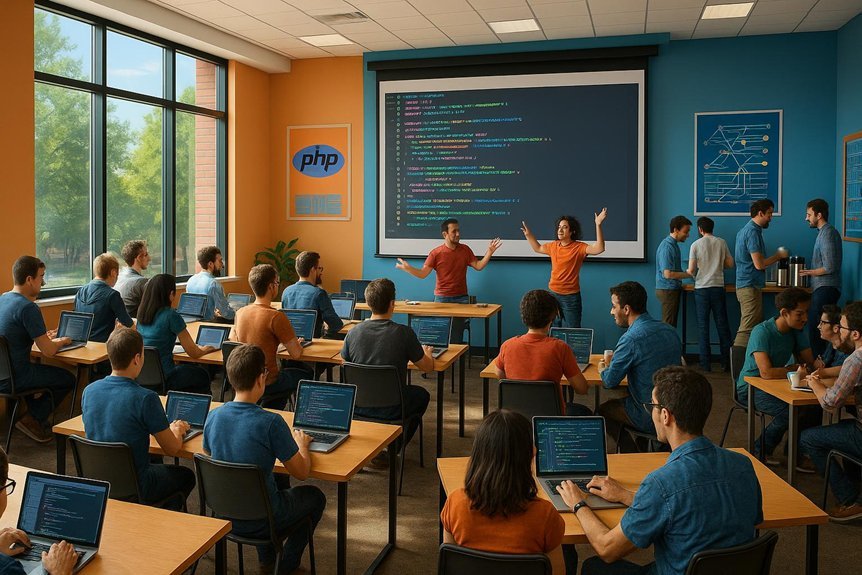
In structuring your PHP day, you’ll focus on collaboration and productivity. Start with morning stand-ups to align goals, then optimize your workspace to minimize distractions. Prioritize tasks using effective time management and regularly assess your progress. Emphasize secure coding and error handling, while drawing on tools like Git for version control. Continuous learning keeps your skills sharp. Interested in learning about handling complex algorithms and end-of-day reflections? There's more to explore.
Essential Tools for PHP Developers
When diving into PHP development, having the right tools is essential for efficiency and effectiveness. PHP frameworks streamline your workflow and enhance code optimization.
Version control systems like Git track changes, while testing tools guarantee reliability. Performance monitoring helps you identify bottlenecks, and code reviews maintain quality.
Version control and testing ensure reliability, while performance monitoring and code reviews uphold quality.
Effective dependency management prevents conflicts, while API integration facilitates seamless communication between services. Error logging aids in quick troubleshooting, and database management secures data integrity.
These tools collectively enhance your development process, enabling you to build strong applications efficiently and with confidence.
Starting the Day With Morning Stand-Ups
Morning stand-ups are a pivotal part of a PHP developer's day, encouraging team communication and alignment. They kick off with morning motivation, boosting energy for the day.
You'll engage in status sharing, where project updates and task prioritization happen in real-time. This guarantees goal alignment and highlights action items.
Through daily feedback, you're encouraged to maintain a collaborative spirit, strengthening team cohesion. These meetings are designed to be brief, yet effective, promoting clear team communication.
Liberation Way's helpline is free, confidential, and available 24/7. A treatment specialist can help you understand your options.
Call (866) 275-3142Setting Daily Goals and Planning Tasks
Effective task planning is essential to a productive day for PHP developers. Start by setting clear goals and prioritize tasks to boost daily motivation. Use time management and productivity techniques to stay on track. Focus strategies guarantee you’re tackling the most important work first. Implement progress tracking and agile planning to adapt and maintain workflow efficiency. Accountability partners can help keep you on target.
| Goal Setting | Task Prioritization | Progress Tracking |
|---|---|---|
| Define objectives | Rank tasks by value | Monitor milestones |
| Set deadlines | Align with goals | Review outcomes |
| Clarify scope | Allocate resources | Adjust plans |
| Communicate plans | Focus on impact | Measure success |
| Evaluate daily | Reassess priorities | Report progress |
Creating a Focused Workspace
To create a focused workspace for your PHP projects, start by minimizing distractions, such as notifications and background noise.
Organize your digital tools by categorizing files and using a reliable code editor to streamline your workflow.
This approach will help you maintain concentration and enhance productivity throughout your day.
Minimizing Distractions Effectively
While setting up a workspace, minimizing distractions is essential for maintaining focus and productivity. Start by implementing distraction techniques like digital detox to reduce unnecessary screen time.
Adopt focus strategies through attention training and mindfulness practices to enhance concentration. Prioritize tasks using effective time management and task prioritization methods to streamline your workflow.
Environment adjustments, such as organizing your space and removing clutter, further support productivity tips. Create a serene atmosphere that builds mental clarity.
Organizing Digital Tools
When organizing digital tools, it’s crucial to streamline your workspace to enhance focus and efficiency.
Achieve this by optimizing digital organization and ensuring seamless tool integration. Use project management software for task prioritization and resource allocation.
Use cloud storage for easy access to files and automation tools to handle repetitive tasks. Version control keeps your code snippets organized, while collaborative platforms facilitate teamwork.
- Utilize project management: Prioritize tasks and allocate resources effectively.
- Accept cloud storage: Keep files accessible and secure.
- Apply automation tools: Minimize repetitive efforts.
- Integrate version control: Maintain organized code snippets and history.
This approach encourages a focused, productive environment.
Getting Comfortable With Git
As you get comfortable with Git, start by mastering basic commands like commit, push, and pull.
Understanding branching and merging techniques will streamline your workflow and reduce conflicts.
Collaborating on GitHub allows you to efficiently manage code with your team, ensuring a cohesive development process.
Understanding Basic Git Commands
Mastering basic Git commands is vital for any developer aiming to streamline their workflow and collaborate effectively. With Git, you’ll harness version control to manage your code efficiently.
Understanding git basics like repository management and commit messages is important. You’ll also deal with remote repositories to guarantee smooth collaboration with others.
Here are key commands to get you started:
- git init: Initialize a new repository.
- git clone: Copy an existing repository.
- git commit: Save changes with a clear commit message.
- git pull: Update your local repository from a remote one.
Tackle merging conflicts and explore branching strategies to enhance your development process.
Branching and Merging Techniques
Building on your understanding of basic Git commands, branching and merging techniques are next in line to enhance your development workflow.
Effective branching strategies like feature branching and collaborative branching help manage version control seamlessly. By creating separate branches for new features, you streamline release management and maintain code integration integrity.
Merging workflows guarantee changes are integrated smoothly, often using pull requests to facilitate collaboration. Handling conflict resolution efficiently is vital when integrating diverse code changes.
Good repository management practices support these processes, making sure your team can work concurrently without issues. Mastering these techniques boosts your project's success.
Collaborating With Github
When you're collaborating with GitHub, understanding Git becomes essential for effective teamwork. Mastering version control and repository management enhances project management and team collaboration.
Key elements include:
- Pull requests: Facilitate code reviews and manage code contributions efficiently.
- Branch strategies: Prevent merge conflicts and streamline collaborative coding.
- Commit messages: Guarantee clarity and context in teamwork dynamics.
- Issue tracking: Improve workflow automation and address open source challenges.
Writing Clean and Efficient PHP Code
Crafting clean and efficient PHP code is essential for comprehensive and maintainable applications. Focus on code readability and performance optimization by following best practices.
Implement refactoring techniques and guarantee thorough code documentation. Utilize design patterns for a clean architecture, and conduct code reviews to prevent errors.
Adopt unit testing and modular programming to enhance reliability. Use version control for tracking changes and managing dependencies effectively.
Adhere to code standards and employ security practices to safeguard your application. By integrating these strategies, you’ll build efficient, scalable PHP projects that are easy to maintain and extend.
Avoiding Common PHP Mistakes
To avoid common PHP mistakes, focus on effective error handling practices and writing secure code.
Implementing proper error handling helps you identify and fix issues efficiently, while secure coding prevents vulnerabilities.
Error Handling Practices
Although mastering PHP can elevate your development skills, common mistakes in error handling often trip up beginners and seasoned developers alike. Effective practices guarantee smoother code execution and user experience.
Focus on:
- Exception management: Use try-catch blocks to handle exceptions gracefully and prevent runtime errors.
- Error logging: Implement logging to track issues, making it easier to identify and fix problems promptly.
- Debugging techniques: Utilize tools like Xdebug to step through code, helping you pinpoint errors quickly.
- User feedback: Provide clear messages to users when errors occur, ensuring they understand the issue without exposing sensitive details.
Adopt these strategies for thorough PHP applications.
Secure Code Writing
When you're writing secure PHP code, understanding the common pitfalls can greatly enhance your application's safety.
Start with secure coding practices to minimize vulnerabilities. Use code review techniques to catch errors early. Conduct regular vulnerability assessments and threat modeling to anticipate potential risks.
Draw on secure libraries usage to avoid reinventing the wheel. Implement strong input validation strategies to prevent injection attacks. Incorporate encryption implementations to protect sensitive data.
Guarantee secure session management to maintain user integrity. By focusing on these areas, you can considerably strengthen your PHP application's security and reduce the likelihood of common coding mistakes.
Effective Debugging Strategies
Debugging is a critical skill that can save you countless hours in PHP development. To enhance your effectiveness, consider these strategies:
Debugging is essential for PHP development, offering strategies to save time and improve efficiency.
- Debugging tools: Use tools like Xdebug for effective error tracing and stack traces.
- Log analysis: Analyze logs to uncover hidden issues and understand performance profiling.
- Code reviews and automated testing: Regular reviews and tests catch bugs early, supporting test driven development.
- Exception handling: Implement comprehensive exception handling to manage unexpected errors gracefully.
These techniques streamline your debugging process, ensuring you spend more time building and less time fixing.
Take on these methods to boost your PHP development efficiency.
Take a Break: Refresh and Recharge
Taking regular breaks is essential to maintaining productivity and focus during a PHP day.
You should consider ideal break timing to maximize effectiveness, incorporate energizing snacks like nuts or fruit, and practice mindful relaxation techniques such as deep breathing.
These strategies help you refresh and recharge, ensuring you return to coding with renewed energy.
Optimal Break Timing
Amid the hustle of a PHP day, optimizing break timing is essential to maintain productivity and mental clarity. Break frequency impacts your workflow efficiency and creative recharge.
Here’s how to make the most of your breaks:
- Timed intervals: Schedule breaks after every 90 minutes to enhance focus restoration.
- Physical movement: A short walk or stretching boosts both mental and physical energy.
- Productivity boosts: Regular breaks prevent burnout and keep you motivated.
- Creative recharge: Stepping away from tasks can spark new ideas and insights.
Energizing Snack Ideas
Breaks aren't just about resting; they're also about replenishing your energy.
Opt for healthy snacks to keep your mind sharp and body fueled. Quick bites like protein bars and nut mixes serve as excellent energy boosters.
Brain foods, such as fruit smoothies and veggie sticks, provide essential nutrients without the crash. Preparing yogurt parfaits in advance can make snack prep a breeze, ensuring you have nutritious options ready.
Incorporate a variety of these snacks to maintain focus and productivity throughout your day.
Mindful Relaxation Techniques
While it's easy to get caught up in daily tasks, incorporating mindful relaxation techniques can greatly enhance your productivity.
Consider these practices to refresh and recharge:
- Mindful Breathing & Guided Meditation: Center yourself with deep breaths and meditation sessions.
- Nature Walks & Digital Detox: Disconnect from screens and reconnect with nature’s tranquility.
- Stretching Exercises & Sound Therapy: Relieve tension with stretches and soothing sounds.
- Journaling Prompts & Gratitude Exercises: Reflect on your day and focus on gratitude.
Utilize aromatherapy benefits to elevate your relaxation.
These mindfulness practices not only reduce stress but also boost overall well-being.
Collaborative PHP Coding: Benefits of Pair Programming
Pair programming in PHP offers a dynamic approach to coding where two developers work together at a single workstation. This method delivers numerous benefits, including enhanced creativity and problem solving, as ideas flow more freely between partners.
Collaborative coding boosts skill sharing, allowing both developers to learn from each other, developing a valuable knowledge exchange. You'll notice increased productivity as effective communication and instant peer feedback streamline the development process.
This technique also improves code quality, as two sets of eyes catch errors more efficiently. Taking on pair programming can transform your PHP projects through its collaborative and innovative nature.
Optimizing Database Interactions With PHP
When optimizing database interactions with PHP, focus on using efficient query techniques to reduce load times and improve performance.
Implementing connection pooling strategies can further enhance efficiency by reusing database connections rather than opening new ones for each request.
These practices help you manage resources effectively, ensuring a smoother and faster application.
Efficient Query Techniques
To optimize database interactions with PHP, focus on efficient query techniques that minimize resource usage and improve application performance.
Start with query optimization to enhance data retrieval speed. Use index usage to accelerate searches and joins. Implement caching strategies for frequently accessed data, reducing load times.
Performance tuning can be achieved by evaluating execution plans and query profiling to identify bottlenecks.
- Database Normalization: Structure data logically to avoid redundancy.
- Load Balancing: Distribute database requests to maintain stability.
- Query Profiling: Analyze and refine slow queries.
- Execution Plans: Understand and optimize how queries are executed.
These techniques guarantee efficient database handling.
Connection Pooling Strategies
A effective connection pooling strategy can greatly improve PHP application performance by managing database connections efficiently. By implementing connection pooling, you enhance resource management and database efficiency, allowing multiple connections to be reused.
This approach aids in performance optimization and load balancing, guaranteeing your system can handle increased traffic with ease.
Query caching further boosts speed, while a scalable architecture supports growth. Effective concurrency handling assures that multiple sessions don’t overload the system.
Using database drivers designed for pooling enhances session management. This strategy helps create a more resilient environment, making your PHP applications faster and more reliable under varying loads.
Exploring New PHP Frameworks
Although PHP has been around for decades, the landscape of frameworks continues to evolve, offering developers new tools and methodologies.
When exploring new PHP frameworks, consider several key factors:
- PHP framework comparisons: Analyze different options to see which fits your needs.
- Emerging PHP technologies: Stay updated with the latest advancements.
- Framework performance benchmarks: Evaluate speed and efficiency.
- User experience considerations: Guarantee ease of use for both developers and end-users.
Also, assess framework community support for troubleshooting, best practices adoption for quality code, and learning curve analysis to gauge how quickly you can master the framework.
Finally, explore framework scalability features to handle growing demands.
PHP Security Measures Every Developer Should Know
After exploring new PHP frameworks, it's important to focus on PHP security measures every developer should know.
Start with secure coding practices and conduct regular vulnerability assessments. Guarantee data validation to prevent injection attacks.
Manage sessions securely to protect user information, and apply thorough encryption techniques for sensitive data.
Implement strict access controls to limit unauthorized entry. Choose secure frameworks that offer built-in security features.
Engage in threat modeling to identify potential risks and plan defenses.
Regularly perform security audits and thorough code reviews to catch vulnerabilities early.
These steps will strengthen your PHP applications against potential threats.
Testing Your PHP Code: Methods and Tools
When developing PHP applications, testing your code is essential to guarantee reliability and functionality. You’ll want to explore various methods and tools to enhance your testing process:
- Unit testing with the PHPUnit framework verifies each part functions correctly.
- Utilize mock objects to simulate behavior during test automation.
- Integration testing checks how components work together, confirming overall system integrity.
- Apply code coverage and performance profiling to identify untested code and optimize efficiency.
Apply debugging tools and error logging to catch issues early.
Accept test driven development to build strong applications from the ground up.
Afternoon Check-In: Adjusting Your Progress
Testing your PHP code sets a strong foundation, and now it’s time to assess your progress in the afternoon check-in.
Focus on progress tracking and identify necessary afternoon adjustments. Engage in feedback sessions to gather insights from team collaboration.
Evaluate performance metrics to confirm you’re on the right track. Use coding checkpoints to see if your tasks align with initial goals.
If needed, consider goal realignment to keep your project on course. Prioritize tasks based on urgency and importance, guaranteeing your efforts match project demands.
This structured approach keeps your PHP development process efficient and goal-oriented.
Tackling Complex Algorithms
- Analyze the problem: Clearly define what needs solving.
- Choose data structures: Select the most suitable complex data structures for your task.
- Draft a plan: Outline the algorithm step-by-step.
- Optimize and test: Refine your algorithm for better performance.
End-of-Day Reflection: What Did You Learn?
After tackling complex algorithms, it's valuable to engage in an end-of-day reflection. Start by summarizing lessons learned and assess your skills.
Evaluate your projects to identify code insights and determine how effectively you applied knowledge. Use reflection techniques to pinpoint areas of personal growth and refine your understanding.
Consider the learning outcomes: what challenges did you overcome? How did your approach improve?
This reflection not only highlights your progress but also helps shape future goals. By consistently evaluating your work, you guarantee continuous improvement and readiness for new challenges, enhancing both your confidence and competence in PHP development.
Continuous Learning: Staying Updated in PHP
To stay ahead in PHP development, it's crucial to engage in continuous learning. You can expand your skills through various methods:
- PHP communities: Join forums and groups to exchange ideas and solutions.
- Online resources: Explore video tutorials and coding podcasts for fresh insights.
- Conference events and PHP workshops: Attend to learn from experts and network.
- Peer mentorship and blog subscriptions: Connect with mentors and follow blogs for the latest trends.
Make time for documentation reading and coding challenges.
Staying updated guarantees you're equipped with the latest PHP advancements, keeping your development skills sharp and competitive.